
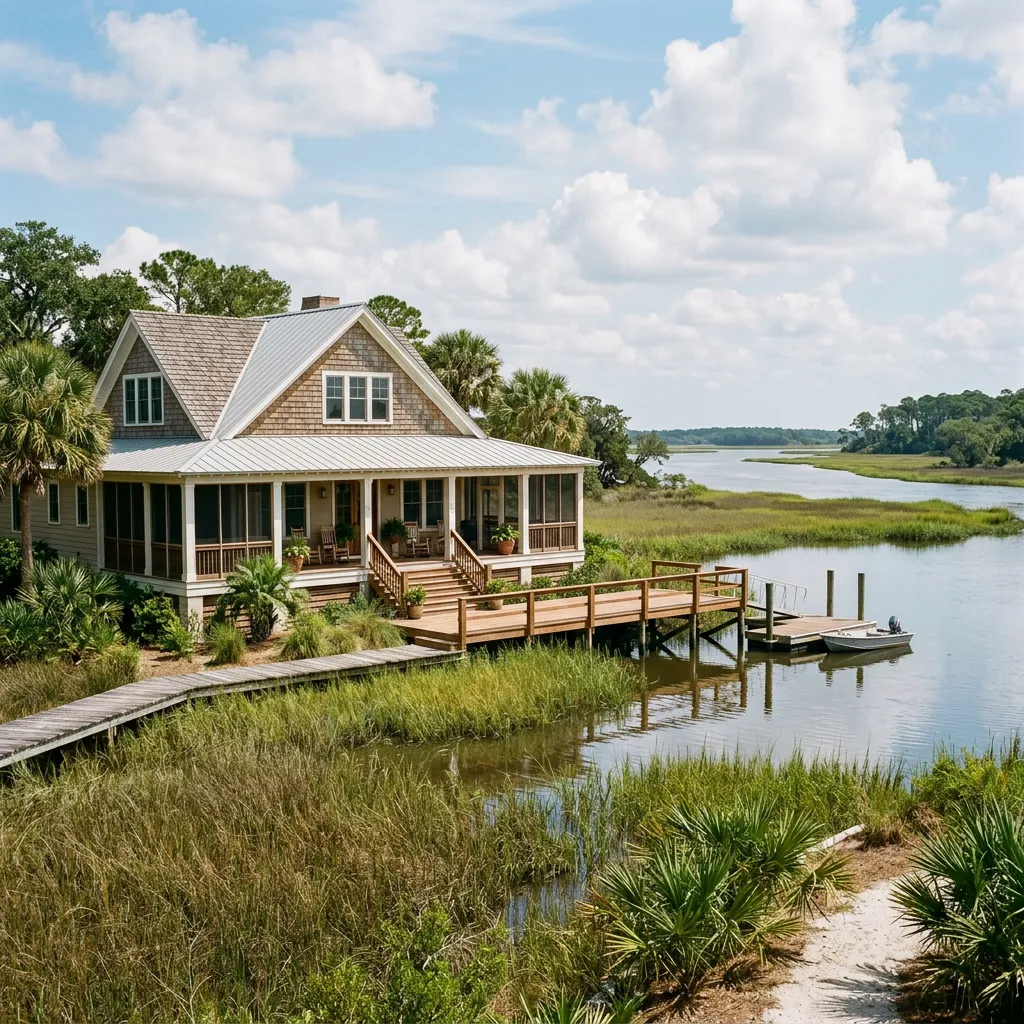
Buying Near the Water in Northeast Florida: What Buyers Should Know
Living near the water is one of the things that draws people to Northeast Florida.
Between the Atlantic Ocean, Intracoastal Waterway, St. Johns River, creeks, marshes, canals, and ponds throughout the region, buyers can find everything from true waterfront homes to neighborhoods where water is simply part of the landscape.
But buying near the water requires a little more homework.
The view may be what gets your attention, but flood exposure, insurance, elevation, drainage, construction, inspections, and maintenance can all affect what the property costs to own and how comfortable you are with the risk.
That does not mean buyers should automatically avoid homes near the water.
It means the water should be evaluated with the same care as the kitchen, floor plan, neighborhood, and purchase price.
Start With the Flood Map, but Do Not Stop There
One of the first things buyers often ask is:
"What flood zone is this house in?"
That is an important question, but the answer does not tell you everything about the property's flood risk.
FEMA flood maps identify areas with different levels and types of flood hazard. Areas designated as Special Flood Hazard Areas represent higher mapped flood risk and can affect whether a lender requires flood insurance.
But being outside one of those higher-risk areas does not mean a home cannot flood.
Heavy rainfall, drainage problems, storm surge, overflowing waterways, changes in surrounding development, and other conditions can create flooding outside the highest-risk mapped areas.
Florida's Office of the Insurance Consumer Advocate specifically reminds homeowners that flooding can occur outside traditionally high-risk areas.
That is why I would treat the flood map as a starting point rather than the entire analysis.
Look at the Specific Property, Not Just the Neighborhood
Two homes on the same street can have different characteristics.
One may sit higher than the surrounding lots. Another may be lower.
One property may drain well after heavy rain while another holds water in the backyard.
A house may also have been elevated differently from neighboring properties or modified over time.
When evaluating a home near the water, consider:
Lot elevation
Finished-floor elevation
Drainage patterns
Grading around the home
Nearby retention ponds
Creeks, marshes, canals, or waterways
Stormwater systems
Signs of previous water intrusion
Seller disclosures
Flood history, when information is available
Whether an Elevation Certificate exists
An Elevation Certificate contains information about a building's elevation in relation to floodplain information and can be useful in certain floodplain, permitting, and insurance situations. FEMA maintains the official Elevation Certificate form and guidance.
The important point for buyers is that the individual parcel matters.
Do not assume every property in a neighborhood carries exactly the same risk simply because the addresses are close together.
Homeowners Insurance and Flood Insurance Are Different
This distinction is extremely important in Florida.
A standard homeowners insurance policy generally does not cover flood damage. Florida's Department of Financial Services explains that flood coverage usually requires a separate flood policy or, depending on the insurer, a flood endorsement.
That means a buyer can have homeowners insurance and still not have coverage for damage caused by rising floodwater.
Flood insurance may be available through the National Flood Insurance Program, commonly called the NFIP, or through private flood insurers in Florida.
When comparing homes, ask for actual insurance quotes rather than assuming what coverage will cost.
Your flood zone is part of that conversation, but insurers may consider additional property and policy characteristics when pricing coverage.
Your Lender May Require Flood Insurance
If you are financing the purchase, the lender may require flood insurance depending on the property's location and the type of mortgage.
Homes securing certain federally backed loans within a Special Flood Hazard Area are generally subject to federal flood insurance requirements.
But even when flood insurance is not required by the lender, a buyer can still choose to purchase it.
That is an important distinction:
"Not required" does not mean "no flood risk."
Your decision should consider the property, your financial exposure, the cost of coverage, and your own comfort level.
Get Insurance Quotes Earlier in the Buying Process
Insurance should not be something you investigate a day or two before closing.
Once you become seriously interested in a property, it can be helpful to begin understanding both homeowners and flood insurance costs.
That is particularly true for:
Waterfront homes
Older homes
Homes in mapped flood hazard areas
Properties with older roofs
Homes with previous claims
Properties with unusual construction
Homes with docks, seawalls, or other waterfront improvements
The total monthly cost of a house should include the insurance picture.
A home that looks affordable based on principal and interest may feel very different after homeowners insurance, flood coverage, property taxes, HOA dues, and CDD assessments are added.
Understand What a Flood Policy Actually Covers
Flood insurance is its own type of coverage, and buyers should understand what they are purchasing.
Florida's Department of Financial Services explains that flood policies can come from the NFIP or the private market and that coverage terms can differ depending on the policy type.
For example, the standard NFIP policy does not include additional living expense coverage if you have to live elsewhere while your flooded home is repaired. Some private-market options may provide broader benefits depending on the policy.
That is why comparing premiums alone may not be enough.
Ask your insurance professional:
What causes of loss are covered?
What is the deductible?
What are the building limits?
What personal-property coverage is included?
Is contents coverage replacement cost or actual cash value?
Is additional living expense included?
Are there exclusions important to this property?
What waiting periods apply?
Are docks, seawalls, detached structures, or other improvements covered?
The cheapest policy may not necessarily provide the coverage you expect.
Pay Attention to Drainage During the Showing
You do not have to be directly on the ocean or river for drainage to matter.
Florida can receive intense rainfall, and the way water moves around a property can be very important.
When walking around the home, look at:
Whether the yard slopes toward or away from the house
Low areas where water may collect
Downspout locations
Gutters
Drainage swales
Storm drains
Retention ponds
Erosion
Staining around exterior walls
Algae or moisture patterns
Neighboring properties that sit higher
Irrigation and landscaping
You may not see drainage problems on a dry day.
If there has been recent rain, however, the property may give you useful clues about how water behaves.
A home inspection can also help identify visible drainage and moisture concerns that deserve additional investigation.
Moisture Matters Even When Flooding Is Not the Problem
Flooding and moisture intrusion are not the same thing.
A house may never experience a true flood but still have problems related to water intrusion.
In Northeast Florida, moisture can enter through or around:
Roofs
Windows
Doors
Stucco
Siding
Flashing
Plumbing
Exterior penetrations
Poor drainage
Failed sealants
Florida's homeowners insurance guidance also distinguishes flood from other forms of water damage, making it important to understand both the physical cause and the policy language.
When buying near the water, pay attention to musty odors, stained drywall, bubbling paint, swollen baseboards, damaged flooring, corrosion, repeated patching, or other signs that water may have been present.
Those signs do not automatically mean there is a major problem.
They do mean you should find out more.
Coastal Air Creates Its Own Maintenance Considerations
Living closer to the ocean can mean exposure to salt air.
Salt can accelerate corrosion on certain metals and exterior components.
Depending on the location and exposure, buyers may want to pay attention to:
HVAC equipment
Exterior fasteners
Railings
Doors and hardware
Outdoor fixtures
Electrical components
Pool equipment
Screens and enclosures
Docks and lifts
Vehicles and recreational equipment
This does not make a coastal home a poor investment.
It simply means maintenance expectations may differ from a similar home farther inland.
Understanding those expectations before buying makes it easier to budget for them.
Waterfront Structures Need Their Own Evaluation
If the property includes a seawall, dock, boat lift, bulkhead, or other waterfront improvement, do not treat those as decorative extras.
They can be valuable features, but they can also represent significant maintenance or replacement costs.
A standard home inspection may not fully evaluate specialized marine structures.
Depending on the property, a buyer may want additional evaluation by an appropriate qualified professional.
Questions worth asking include:
How old is the seawall?
Has it been repaired?
Are there visible cracks or movement?
Is there erosion behind it?
What condition is the dock in?
How old is the boat lift?
What is the lift capacity?
Are permits available?
Who is responsible for maintenance?
Are there restrictions on repairs or replacement?
If access to the water is one of the reasons you are buying the property, those features deserve as much due diligence as the home itself.
Ask About Permits and Prior Improvements
Waterfront and coastal properties can have additional regulatory considerations.
A dock that exists today may have been permitted under different rules than would apply to a new dock.
A seawall repair, addition, enclosure, major renovation, or elevation project may also have a permit history worth reviewing.
Buyers should not assume that because a structure exists, every past improvement was properly permitted.
When something appears unusual or significant, checking public permit records can provide helpful context.
Wind Exposure Matters Too
Flood risk gets much of the attention near the coast, but wind exposure is another major part of owning a Florida home.
A property's roof, openings, construction features, and wind-mitigation characteristics can affect both storm performance and homeowners insurance.
Florida insurance guidance recognizes hurricane and windstorm coverage as an important part of homeowners coverage, while also noting that coverage can vary by policy and insurer.
Depending on the home, buyers may obtain a wind-mitigation inspection to document qualifying construction features for an insurer.
This is another reason that a home's condition and construction can matter just as much as its location.
Older Waterfront Homes Deserve Extra Due Diligence
Older waterfront homes can be beautiful.
They may offer larger lots, mature landscaping, established neighborhoods, direct water access, and locations that cannot easily be replicated with new construction.
But age can bring additional questions.
Look closely at:
Roof age
Electrical system
Plumbing
HVAC
Windows and doors
Exterior materials
Foundation or structural components
Prior additions
Drainage
Moisture history
Seawalls and docks
Insurance availability
A lower purchase price can become less attractive if several major components are approaching replacement at the same time.
That does not mean older is bad.
It means condition should be evaluated alongside price.
New Construction Near Water Still Needs Inspection
New construction can reduce some age-related concerns, but it does not eliminate the need for due diligence.
Buyers should still pay attention to:
Grading
Drainage
Lot elevation
Retention ponds
Stormwater design
Roof installation
Windows and doors
Exterior waterproofing details
Stucco or siding
Landscaping
Irrigation
New homes are built by people and involve many different trades.
A new-construction inspection can identify issues that are easier to address before closing or while builder warranty protections may still apply.
If the lot backs up to water, marsh, conservation land, or a retention pond, make sure you understand exactly what that feature is and how it may affect the property.
Retention Pond Is Not the Same as Waterfront
This comes up regularly in newer Florida communities.
A house may be advertised with a "water view," but that water may be a stormwater retention pond rather than a navigable lake, river, or natural body of water.
That is not necessarily a negative.
Many buyers enjoy the additional separation from rear neighbors and the open view.
But you should know what you are looking at.
Ask:
Is it a retention pond?
Who maintains it?
Does the water level fluctuate?
Is there an easement?
Are fences restricted?
Are there drainage structures nearby?
Is fishing permitted?
Are there wildlife considerations?
Understanding the feature helps prevent assumptions based solely on listing language.
Think About Resale Before You Buy
A waterfront or water-adjacent property can have strong lifestyle appeal, but buyers should still think about resale.
The same features that attract you may attract future buyers.
Likewise, issues that concern you today may concern future buyers.
Flood zone, insurance cost, seawall condition, dock condition, erosion, drainage, and maintenance can all become part of the resale conversation later.
That does not mean you should avoid a property because one of these considerations exists.
It means you should understand it before deciding what the property is worth to you.
What Should You Ask Before Making an Offer?
When you find a home near the water that you love, slow the process down enough to gather the right information.
Useful questions may include:
What FEMA flood zone applies to the property?
Is the property in a Special Flood Hazard Area?
Is an Elevation Certificate available?
Has the property previously flooded?
Are there known drainage concerns?
What are the homeowners insurance estimates?
What are the flood insurance estimates?
How old is the roof?
Are there wind-mitigation features?
Is there a seawall, dock, or lift?
What condition are those structures in?
Are waterfront improvements permitted?
Are there HOA restrictions affecting the water or dock?
What maintenance should I expect?
How do these costs compare with another property farther inland?
Those answers can help turn an emotional decision into an informed one.
Buying Near the Water Is About Understanding the Tradeoffs
For many Northeast Florida buyers, living near the water is worth it.
It can mean beautiful views, boating access, coastal breezes, wildlife, recreation, or simply the feeling of being connected to the landscape that makes this part of Florida unique.
But the lifestyle comes with considerations that may not exist with every inland home.
Flood exposure, insurance, drainage, salt air, moisture, docks, seawalls, maintenance, and storm preparation should all be part of the buying conversation.
The goal is not to eliminate every possible risk.
No property can offer that.
The goal is to understand the property well enough to decide whether the location, lifestyle, cost, and responsibilities make sense for you, so you can make the right move - not just any move.
Sources: Federal Emergency Management Agency (FEMA), National Flood Insurance Program resources and Elevation Certificate guidance; Florida Department of Financial Services, Homeowners Insurance and Flood Insurance consumer resources. Flood zones, insurance requirements, policy coverage, premiums, and property conditions vary by individual property and policy.