
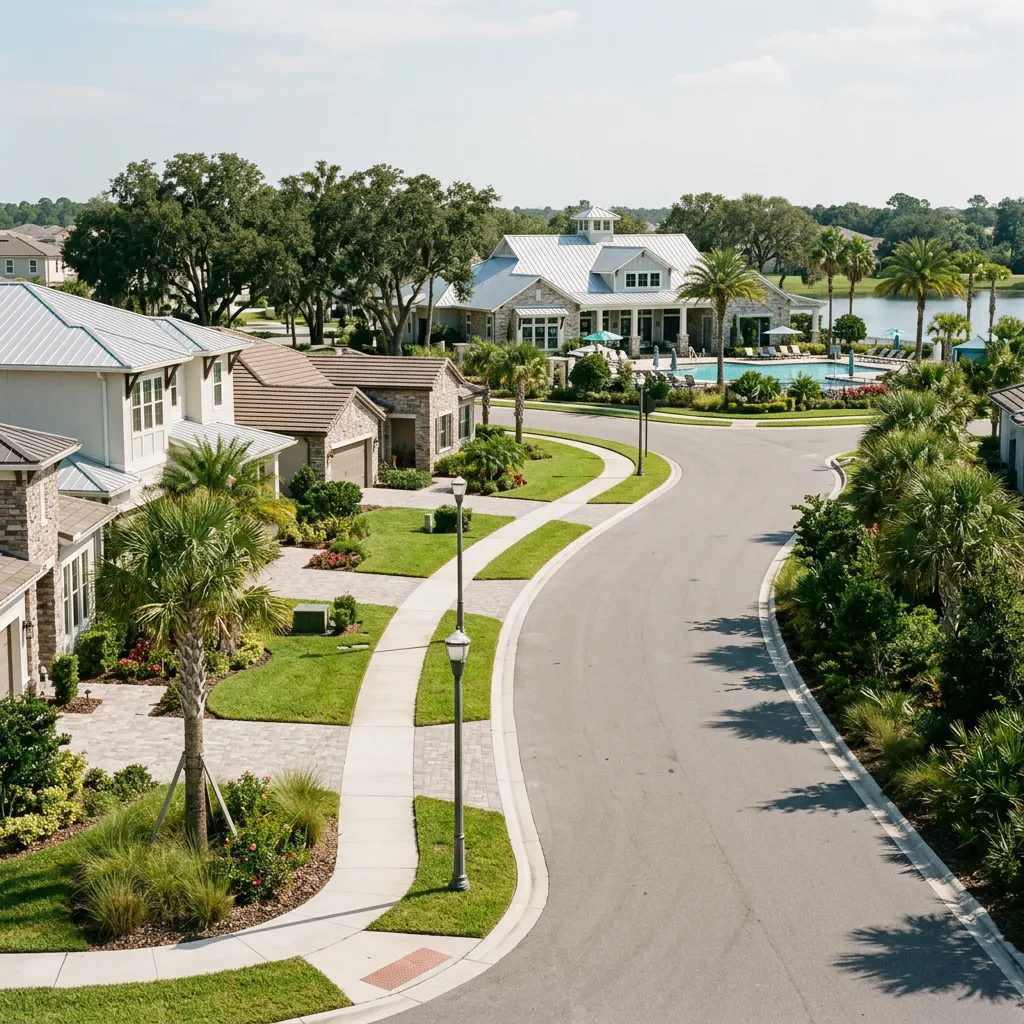
HOA vs. CDD Fees in Northeast Florida: What Buyers Should Know
When buyers compare communities in Northeast Florida, two abbreviations come up constantly: HOA and CDD.
They are often discussed together because both can affect the cost of owning a home, but they are not the same thing.
A homeowners' association, or HOA, is generally an association responsible for operating and enforcing the governing documents of a community. A Community Development District, or CDD, is a type of special-purpose governmental district created under Florida law that can finance and provide infrastructure and community services.
A neighborhood can have an HOA, a CDD, both, or neither.
For a buyer trying to compare homes in places such as Nocatee, SilverLeaf, RiverTown, World Golf Village, or other growing Northeast Florida communities, understanding that difference can make the monthly and long-term cost comparison much clearer.
What Is an HOA?
An HOA is a homeowners' association.
In a mandatory Florida HOA, property owners are members of the association and may be required to pay assessments under the community's governing documents. Florida law defines a homeowners' association as a Florida corporation responsible for operating a community in which membership is a mandatory condition of owning a parcel and the association is authorized to impose assessments.
What an HOA is responsible for varies considerably from one community to another.
HOA assessments may help support things such as:
Common-area maintenance
Landscaping
Community entrances
Pools and amenity centers
Parks and playgrounds
Private roads in some communities
Community management
Gates or security-related services
Recreational facilities
Other shared community expenses
The amount you pay does not necessarily tell you whether an HOA is expensive or inexpensive.
You also need to understand what is included.
For example, one community may have relatively low HOA dues but fewer amenities. Another may have higher dues that include extensive recreational facilities or services you would otherwise pay for separately.
The better question is: What does this HOA assessment cover, and does that provide value for the way I plan to live?
What Is a CDD?
A Community Development District is different.
Florida law provides for CDDs as independent special districts that can manage and finance infrastructure and community development services. Depending on the district, those improvements and services can include roads, drainage and water-management systems, utilities, recreational facilities, landscaping, and other infrastructure authorized under Florida law.
In many developing communities, a CDD provides a way to finance significant infrastructure needed to build out the community.
Property owners within the district may then pay CDD assessments.
These assessments are commonly collected as non-ad valorem assessments on the property tax bill, although Florida law also allows other authorized collection methods. Unlike ad valorem property taxes, non-ad valorem assessments are not calculated simply as a percentage of the property's value.
That distinction matters when you are estimating what a particular home will cost to own.
A CDD Assessment Can Have Different Components
Buyers sometimes hear that a CDD will "eventually go away."
That statement can be misleading.
A CDD assessment may include a portion associated with financing capital improvements, often referred to as debt service, as well as amounts used for ongoing operations and maintenance.
A particular bond-related assessment may have a repayment schedule, but that does not necessarily mean every CDD-related assessment disappears once that debt is satisfied.
The district may continue to have operating, maintenance, service, or future financial obligations.
That is why I would not evaluate a property simply by asking, "Does it have a CDD?"
I would ask:
What is the current annual assessment?
What portion relates to debt service?
What portion relates to operations and maintenance?
Does the property have more than one assessment?
What does the district provide?
What information is available regarding outstanding district debt?
Can assessments change in future years?
The answers can vary by district and even by property within a larger community.
HOA and CDD Costs Should Be Included in Your Home-Buying Budget
When you search for homes online, the listing price naturally gets most of your attention.
But the home with the lowest purchase price is not necessarily the home with the lowest monthly cost.
Consider two hypothetical homes.
Home A has a lower purchase price but includes an HOA assessment and a significant annual CDD assessment.
Home B costs somewhat more but has a smaller HOA assessment and no CDD.
The listing prices alone do not tell you which property fits your budget better.
A more useful comparison includes:
Principal and interest
Property taxes
Homeowners insurance
Flood insurance, if applicable
HOA assessments
CDD assessments
Mortgage insurance, if applicable
Maintenance expectations
Utility costs
Other community-specific expenses
This is especially important for buyers trying to establish a comfortable monthly payment rather than simply qualify for the highest possible purchase price.
Check How the CDD Appears on the Property Tax Bill
Because CDD assessments are often collected through the property tax bill as non-ad valorem assessments, buyers can sometimes overlook them when estimating property taxes.
Florida's Department of Revenue explains that non-ad valorem assessments can appear on the property tax notice and are based on an improvement or service rather than simply the taxable value of the property.
When reviewing a specific property, look at the actual tax information rather than relying solely on a generic tax estimate.
That can help identify assessments associated with the parcel and give you a better starting point for estimating ownership costs.
Also remember that a seller's existing property-tax amount may not represent exactly what a buyer will pay after the transaction.
The objective is to understand the pieces that make up the bill, not simply copy the current owner's total into your budget.
Do Not Compare HOA Fees Without Comparing Amenities
Suppose Community A has an HOA assessment of $100 per month and Community B charges $175 per month.
It is tempting to conclude that Community A is the better value.
But what if Community B includes several pools, fitness facilities, trails, community events, playgrounds, sports facilities, and other amenities that your family plans to use frequently?
Or what if you know you will rarely use any of those amenities?
Neither answer is automatically right.
The value depends on what matters to you.
When touring communities, consider whether you are actually likely to use the amenities you are helping fund.
An impressive amenity center can be exciting during a community tour, but you are purchasing a home and a lifestyle for years, not visiting a resort for an afternoon.
Rules Matter Too
The financial side is only part of evaluating an HOA.
The governing documents can also affect how you use your property.
Depending on the community, rules may address issues such as:
Exterior modifications
Fencing
Boats and recreational vehicles
Parking
Landscaping
Rental restrictions
Pets
Architectural changes
Home-based activities
Signs
Maintenance standards
For some buyers, those standards are part of the appeal because they value consistency throughout the neighborhood.
Other buyers may prefer greater flexibility.
Neither preference is inherently better, but it is much easier to make that decision before buying than after discovering a rule you did not expect.
New Construction Buyers Should Ask About Both
HOA and CDD costs are especially important when evaluating new construction in Northeast Florida.
Do not focus only on the builder's base price, monthly mortgage estimate, or advertised incentive.
Ask what additional community costs apply to the homes you are considering.
Depending on the property, that may include:
HOA assessments
CDD assessments
Amenity fees
Lot premiums
Architectural or capital-contribution fees
Other community or closing-related charges
Builders may also be developing multiple phases within one larger community, so do not assume every section has exactly the same financial structure.
Ask about the specific property you are considering.
Can You Pay Off a CDD?
Sometimes buyers encounter properties where certain CDD debt assessments may be eligible for prepayment.
That does not necessarily mean prepayment is the best financial decision, and it does not necessarily eliminate every future district assessment.
Before making assumptions, a buyer should determine exactly what can be prepaid, the amount required, what portion of the annual assessment would remain afterward, and how long the existing debt assessment is otherwise expected to continue.
If a seller says, "The CDD is paid off," ask what that actually means for that parcel.
The property may no longer have a particular debt-service assessment while still being subject to ongoing district operations and maintenance assessments.
The details matter.
What About Communities With No CDD?
"No CDD" can absolutely be attractive to buyers, but it should not automatically be treated as proof that a community is less expensive.
A community without a CDD may have:
Higher HOA assessments
Fewer amenities
Older infrastructure
Different maintenance responsibilities
Higher expected home-maintenance costs
A higher purchase price
A completely different location or lot profile
For example, an established neighborhood without a CDD may offer mature trees and larger lots, but the homes may also have older roofs, HVAC systems, plumbing, or electrical components.
A newer community with a CDD may offer newer systems and extensive amenities but carry higher recurring community-related costs.
Once again, the useful comparison is the complete ownership picture.
HOA vs. CDD in St. Johns County
This conversation comes up frequently for buyers looking in St. Johns County because the county includes a significant number of newer and master-planned communities.
Nocatee, SilverLeaf, RiverTown, World Golf Village-area neighborhoods, and other communities can have very different combinations of HOA assessments, CDD assessments, amenities, home ages, and purchase prices.
Even within one larger area, different neighborhoods or phases can operate differently.
That makes it difficult to answer broad questions such as:
"How much are the fees in Nocatee?"
or
"Does SilverLeaf have a CDD?"
without looking at the specific property and neighborhood involved.
A buyer considering a particular house should evaluate the actual fees and assessments tied to that parcel rather than relying on a general impression of the larger community.
Should You Avoid a Home Because It Has a CDD?
Not necessarily.
A CDD is a cost, and buyers should understand it.
But whether that cost makes sense depends on the property, community, amenities, infrastructure, purchase price, and your own priorities.
A buyer who loves a particular master-planned community and regularly uses its amenities may consider the overall package worthwhile.
Another buyer may prefer a community with fewer shared amenities and lower recurring fees.
The important thing is making the choice intentionally.
I would be much more concerned about a buyer purchasing a home without realizing the assessment existed than about a buyer who understands it and decides the community is worth the expense.
What Should Buyers Ask Before Making an Offer?
Before committing to a home in an HOA or CDD community, try to understand the financial and practical implications.
Some useful questions include:
What are the current HOA assessments?
How frequently are they paid?
What does the HOA cover?
Are there additional amenity or association fees?
Is the property located within a CDD?
What is the current CDD assessment for this specific parcel?
What portion relates to debt service versus operations?
Are there known special assessments?
What restrictions are important to me?
How do the total costs compare with competing homes?
What amenities and services am I receiving in return?
That information can dramatically improve your ability to compare properties.
The Cheapest Fee Is Not Always the Best Value
Buyers sometimes approach HOA and CDD expenses with one goal: find the community with the lowest fees.
I would approach the decision differently.
First determine your comfortable total housing budget.
Then consider what you receive for the money and whether it fits the lifestyle you actually want.
A home is more than a purchase price, and a community is more than an HOA or CDD number.
The goal is to know what you are paying, understand why you are paying it, and compare the complete cost of each property before deciding which one fits you best.
That information gives you the context to make the right move - not just any move.
Sources: Florida Statutes, Chapter 190 - Community Development Districts and Chapter 720 - Homeowners' Associations; Florida Department of Revenue, Property Tax and Non-Ad Valorem Assessment resources; Florida Special District Accountability Program. HOA requirements and CDD assessments vary by association, district, community, and individual parcel.