
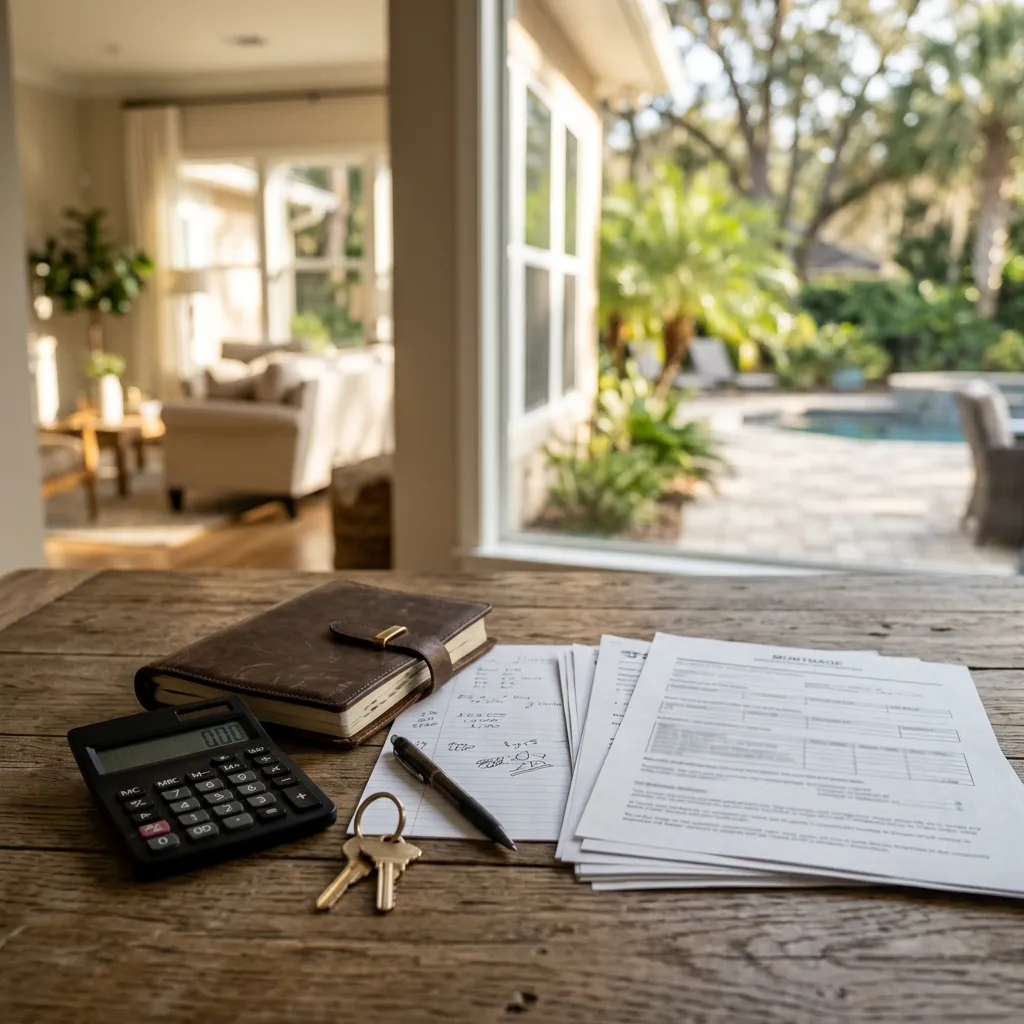
How to Build a Smart Home-Buying Budget in Northeast Florida
When buyers start thinking about purchasing a home, the first financial question is often:
“How much do I need for the down payment?”
That matters, but it is only one piece of the home-buying budget.
The purchase price, interest rate, taxes, homeowners insurance, HOA or CDD assessments, closing costs, inspections, maintenance, utilities, and the amount of savings you want left after closing can all affect what a home truly costs.
This is especially important in Northeast Florida, where two homes with nearly identical prices can produce very different monthly expenses.
A newer home in St. Johns County might have HOA and CDD assessments but fewer immediate maintenance concerns. An established home in Mandarin might have lower community fees but an older roof or HVAC system. A home closer to the coast may introduce different flood and insurance considerations.
So rather than beginning with the maximum amount a lender says you can borrow, I prefer starting with a different question:
What amount can you comfortably spend on housing while still supporting the rest of your life?
That creates a much stronger foundation for a home search.
What You Qualify for and What You Can Comfortably Afford Are Not the Same Thing
A mortgage preapproval tells you what a lender may be willing to lend based on its underwriting criteria.
It does not necessarily tell you what payment will feel comfortable every month.
The Consumer Financial Protection Bureau specifically recommends looking at your entire household budget rather than automatically treating the maximum mortgage qualification as your personal spending limit. A lender does not know every financial priority you have outside the loan.
You may also be saving for retirement, childcare, private school, travel, vehicles, a business, college, emergency reserves, or other goals.
That is why I like establishing a comfortable housing number before establishing a maximum home price.
If you know what you genuinely want your monthly housing costs to be, we can work backward and determine which price ranges and communities fit that number.
Start With the Total Monthly Payment
Online mortgage calculators can be useful, but buyers sometimes focus only on principal and interest.
Your actual monthly housing expense can be significantly higher.
The CFPB notes that a total mortgage payment may also include property taxes, homeowners insurance, and mortgage insurance when applicable. HOA expenses may be paid separately, and buyers should account for those as well.
In Northeast Florida, I would also consider CDD assessments when applicable.
So if a lender shows you a principal-and-interest payment of $2,600, that does not necessarily mean you are buying a home that costs $2,600 per month to carry.
Once property taxes, insurance, HOA dues, CDD assessments, mortgage insurance, and other expenses are included, the real number may look very different.
That is the number I want buyers comparing.
Property Taxes Deserve More Attention Than the Current Tax Bill
This is particularly important for Florida buyers.
Do not assume that the property tax bill shown for the current owner will necessarily become your tax bill after you purchase the property.
Florida's Department of Revenue explains that when ownership changes, a property may be reassessed at just value. The previous owner's exemptions and accumulated Save Our Homes benefit do not simply transfer to a new buyer. Eligible Florida homeowners may later qualify for homestead exemption and, in some situations, portability from a previous Florida homestead.
This can create a surprise if you budget based solely on what the seller currently pays.
For example, someone who has owned a home for many years may have an assessed value well below its current market value because of Florida's Save Our Homes assessment limitation.
When that property sells, the buyer's future tax situation can look different.
That is why I would rather use a realistic estimate for your anticipated ownership than assume the seller's current bill will continue unchanged.
Homestead Exemption Can Matter, but Understand What It Does
If the home will become your permanent Florida residence and you otherwise qualify, you may be eligible for Florida's homestead exemption.
The Florida Department of Revenue explains that the exemption can reduce taxable value by as much as $50,000, subject to how the exemption applies to different taxing authorities. Qualifying homestead property may also receive the Save Our Homes assessment limitation in subsequent years.
That can be valuable.
But I would still budget conservatively when purchasing the house rather than assuming the lowest possible future tax figure before everything has been established.
If you already own a Florida homestead and are moving, it may also be worth determining whether you qualify to transfer, or “port,” some of your Save Our Homes assessment difference.
The specific calculation should be confirmed with the appropriate county property appraiser.
Homeowners Insurance Needs to Be Part of the Search, Not an Afterthought
Insurance can materially change the affordability of a Florida home.
The premium may be influenced by the property's location, roof, age, construction, electrical and plumbing systems, wind-mitigation features, claims history, coverage choices, deductibles, and other factors.
That means two homes with the same price and similar mortgage payments can still have very different total ownership costs.
For older resale homes, I would pay particular attention to the expensive systems that may affect both future maintenance and insurance.
For new construction, newer systems and current construction may help the comparison, but buyers should still obtain an actual insurance quote rather than assuming what the premium will be.
And if the property has flood exposure, flood coverage becomes a separate part of the conversation.
Insurance should be investigated early enough that it can influence your buying decision, not discovered as a surprise shortly before closing.
HOA and CDD Assessments Can Change Which Home Is Actually More Affordable
This is one of the biggest reasons I do not like comparing homes by purchase price alone.
A home priced at $475,000 with HOA and CDD expenses could create a different monthly obligation than another $475,000 property without those assessments.
That does not mean the community with the additional fees is a poor value.
Those assessments may support infrastructure, amenities, recreation, landscaping, common areas, community programming, or other features you want.
The issue is simply that they need to be included in the math.
This becomes particularly relevant when buyers are comparing master-planned communities throughout St. Johns County and other growing parts of Northeast Florida.
The right question is not, “Does this community have a CDD?”
It is, “What is the total cost of owning this particular home, and what am I receiving in return?”
Your Down Payment Is Not the Same as Your Cash to Close
This distinction catches some buyers by surprise.
If you are making a $40,000 down payment, that does not necessarily mean you need exactly $40,000 to complete the purchase.
The CFPB explains that buyers can also encounter lender charges, appraisal and title-related costs, government fees, prepaid interest, homeowners insurance, escrow deposits, and other closing expenses. Your Loan Estimate identifies estimated closing costs and an estimated cash-to-close figure.
That is why I separate three numbers:
Down payment.
Closing-related cash.
Money you want left after closing.
The third number can be one of the most important.
Do Not Empty Your Savings Account Just to Buy the House
Being able to produce the cash needed at closing does not necessarily mean you should use every available dollar to do it.
Homeownership comes with unpredictable expenses.
A water heater fails.
An appliance stops working.
The HVAC needs a repair.
A plumbing problem appears.
You discover something you want to change after moving in.
The CFPB specifically advises buyers not to sacrifice all of their savings simply to purchase a larger home and recommends accounting for emergency savings and future repairs.
I would rather see a buyer purchase a home they can comfortably own than stretch every available dollar just to reach a higher price point.
The financial goal is not merely getting through closing day.
It is being comfortable after closing too.
Build an After-Closing Reserve Into the Plan
There is no single reserve amount that is correct for every buyer.
A newer home with warranties and newer systems creates a different risk profile from a 30-year-old home with several original components.
A condominium may shift some exterior maintenance responsibilities to the association while introducing association dues and the possibility of assessments.
A waterfront property may bring different maintenance concerns than an inland suburban home.
Instead of applying one arbitrary rule to every house, look at the actual property.
If the roof is approaching replacement, account for it.
If the HVAC is older, understand what replacement could cost.
If the home has a pool, include pool maintenance.
If the property has a seawall, dock, or boat lift, those are real ownership assets with real maintenance requirements.
Your reserve strategy should reflect what you are buying.
Think About the First Year, Not Just the First Month
The monthly mortgage payment gets most of the attention during a home purchase.
But some expenses do not happen monthly.
You may pay HOA dues quarterly or annually.
CDD assessments may appear on the tax bill.
Homeowners insurance may change at renewal.
There may be annual pest service, HVAC maintenance, pool service, landscaping, termite protection, or other expenses.
Then there are irregular costs like repairs and replacements.
I like looking at the home as an annual household expense, then dividing that into a monthly planning number.
That makes it harder for quarterly and annual expenses to disappear from the budget.
Utilities Can Change From One House to Another
Buyers relocating from an apartment or a smaller property can underestimate how much utilities may change.
A larger home can mean higher electricity and water consumption.
A pool adds equipment and operating costs.
An irrigation system may affect water usage.
An older home may perform differently from newer energy-efficient construction.
A large yard may require more water and maintenance.
If a property uses septic or well systems, ownership responsibilities differ again.
These expenses probably will not determine whether you love a house, but they belong in the financial picture.
New Construction Has Its Own Budget Traps
New construction can be attractive because of newer systems, builder warranties, financing incentives, and lower immediate maintenance expectations.
But buyers should pay close attention to what is included in the advertised price.
The model home may contain upgraded flooring, cabinets, countertops, lighting, appliances, structural options, landscaping, outdoor living features, or other selections not included in the base price.
There may also be a lot premium.
Then add HOA and CDD expenses where applicable.
Builder incentives can offset some of those costs, particularly when they reduce financing expenses or contribute toward closing costs, but incentives should be evaluated as part of the complete transaction.
A $20,000 incentive is valuable only in the context of what you are paying for the home and how you are allowed to use it.
Resale Homes Require a Different Type of Budget
A resale home may provide an established neighborhood, mature landscaping, a larger lot, a desirable location, or fewer community fees.
But existing systems deserve attention.
A resale budget should consider the condition and expected life of the roof, HVAC, water heater, electrical, plumbing, windows, appliances, exterior materials, and other major components.
A beautifully renovated kitchen does not necessarily mean those systems are new.
The house may still be an excellent purchase.
You simply want future expenses reflected in your decision.
A home that costs $15,000 less but appears likely to require $30,000 of work during the next few years may not actually be the less expensive choice for you.
Maintenance Is Part of the Mortgage Conversation Even Though It Is Not in the Mortgage
Your lender does not collect a monthly maintenance payment.
Your house still does.
Every home requires maintenance.
The amount and timing vary, which makes it tempting to leave maintenance out of the budget completely.
I would rather create a monthly savings amount specifically for the property.
That money may eventually pay for an HVAC repair, exterior painting, plumbing work, appliances, landscaping, roof work, or another household expense.
If nothing breaks for a while, great.
The reserve continues growing.
Your Budget Should Include the Life You Want Outside the House
This may be the most overlooked part of affordability.
Buying a home should not necessarily require you to stop doing everything else you care about.
If travel matters to you, include it.
If you want money available for restaurants, boating, children's activities, investing, retirement, or another business, those priorities do not disappear simply because you purchase a house.
This is why the lender's maximum approval and your personal maximum should not automatically be the same number.
A home should fit into your financial life.
Your entire financial life should not have to reorganize itself around the house.
Use the Loan Estimate to Compare More Than Interest Rates
When you begin comparing mortgage options, look beyond the headline rate.
A Loan Estimate provides information about the interest rate, estimated monthly payment, closing costs, taxes and insurance estimates, and other features of the loan. Lenders generally must provide the Loan Estimate within three business days after receiving a mortgage application.
This becomes especially useful when comparing:
a builder's preferred lender against an outside lender,
a lower rate that requires points against a higher rate with lower upfront cost,
or one loan structure against another.
The cheapest-looking rate is not automatically the least expensive financing option for your situation.
Look at what you pay now, what you pay each month, and how long you realistically expect to keep the loan.
Seller and Builder Credits Can Help, but They Do Not Replace a Budget
Closing-cost assistance can reduce the amount of cash a buyer needs at closing.
That can be extremely useful.
But a credit should improve an already workable purchase rather than create the illusion that an unaffordable home suddenly became affordable.
The CFPB notes that seller or lender credits can involve financial tradeoffs. A lender credit, for example, may be associated with a higher rate, while seller credits are ultimately part of the economics of the overall transaction.
Look at the complete numbers.
How much cash are you saving?
What is the purchase price?
What is the interest rate?
What is the monthly payment?
What are the recurring costs?
What remains in savings after closing?
That tells you much more than the size of the advertised credit.
Compare Communities Using the Same Budget
Suppose you are considering homes in SilverLeaf, RiverTown, Nocatee, World Golf Village, Mandarin, and another established Northeast Florida neighborhood.
Do not create a separate financial standard for each one.
Start with the amount you are comfortable spending.
Then run each community through the same framework.
One may provide a newer home but carry greater community expenses.
Another may have lower recurring fees but older housing inventory.
Another may cost more because of location while reducing your commute.
A slightly more expensive home can sometimes make sense when the complete ownership picture is stronger.
A less expensive home can sometimes become surprisingly expensive once the other numbers are added.
Using one consistent budget makes those tradeoffs easier to see.
Leave Room for the Payment to Change
Homeownership expenses are not frozen forever.
Property taxes can change.
Insurance premiums can change.
HOA dues can change.
CDD operations and maintenance assessments can change.
Utility costs can change.
Maintenance needs generally increase as homes and systems age.
If your budget works only when every expense remains exactly where it is today, you may be leaving yourself very little flexibility.
I prefer a housing payment that provides some breathing room.
Think in Terms of Comfortable, Target and Maximum
A useful way to approach the search is to establish three numbers.
Your comfortable number is where the total ownership cost fits easily within your household budget.
Your target number may be slightly higher if the property strongly meets your priorities.
Your maximum number is the line you do not cross.
That makes it much easier to evaluate homes when emotions enter the process.
If you find a house you love, you already know whether stretching another $25,000 still fits the plan or takes you beyond the limit you established while thinking clearly.
It also helps prevent gradual price creep during the search.
The Purchase Price Is Only the Beginning of the Comparison
A smart home-buying budget looks beyond what the home costs to purchase.
It considers what the home costs to own.
That means understanding the mortgage, taxes, insurance, HOA and CDD assessments, utilities, maintenance, immediate repairs, closing costs, and the savings you want to preserve.
It also means acknowledging that your financial goals outside real estate still matter.
When you know those numbers before you fall in love with a house, you can compare properties much more objectively.
You are no longer asking only, “Can I buy this?”
You are asking the much more useful question:
“Does owning this home fit the life and financial plan I actually want?”
Answer that first, and you are in a much stronger position to make the right move - not just any move.
Sources: Consumer Financial Protection Bureau, mortgage affordability, Loan Estimate, closing-cost and homeownership-cost resources; Florida Department of Revenue, Florida Property Tax, Homestead Exemption and Save Our Homes resources. Mortgage costs, taxes, insurance, HOA and CDD assessments, exemptions and maintenance expenses vary by buyer and individual property and should be verified for the specific transaction.